
Course Description
Course Overview
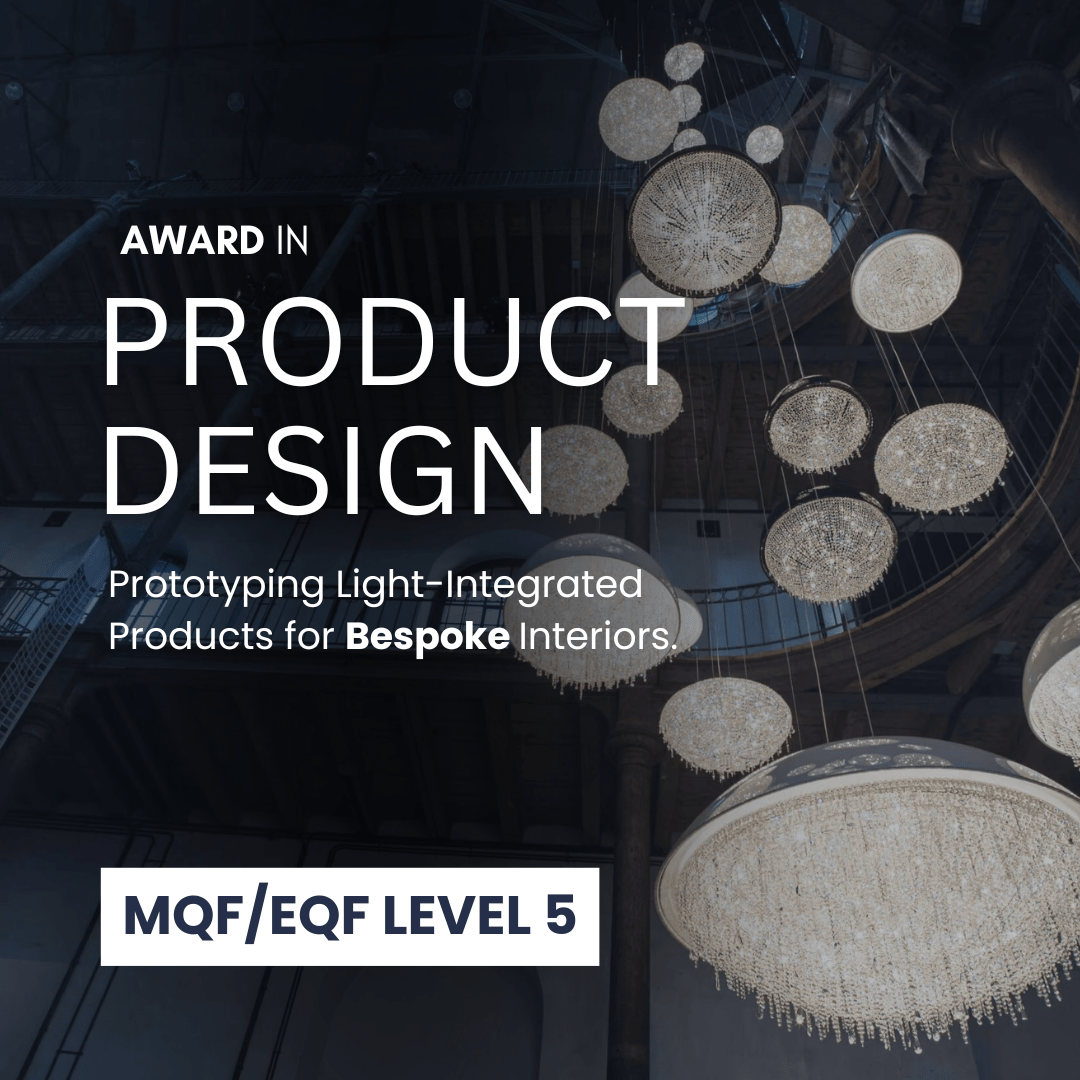
This full-immersion, hands-on, product design course explores the principles, technologies and different strategies for development and prototyping of aesthetically appealing and functional products designed to enhance living experiences in various 3-dimensional spaces and settings, focusing mainly on interior spaces.
This course equips participants with the skills needed to create exceptional interior design products. From bespoke furniture to custom light fixtures, students will explore innovative approaches to designing and crafting unique prototypes, become a fully-fledged ‘Designer-Maker’, experiment with model making, 3D modelling and 3D printing, LED light installation and the effective presentation of products.
Who is this course for?
This course is perfectly designed for individuals with interest in turning their ideas into products!
Whether you are a crafty person, an entrepreneur wanting to turn your ideas into market or a professional designer, architect designing bespoke products for your client this program!
Relation to Occupations: Construction (Finishes), Lighting, Interior Design & Architecture, Bespoke design, Product Design & Development, Stage design, Entrepreneurship, Project management, Sales industries
Study mode: Project-based (exam free) | Duration: circa 30 hours (Lectures)
Total hours of Learning: 150 – incl. Lectures (30); Placement/Practice (20); Assessment/Project work (30); Self study (70)
Entry level: Beginner course. No prior experience or knowledge required
Qualification: Award EQF/MQF 5 | 6 ECTS
What will you Learn after this course?
to be updated…
Project-work
This course is 100% project-based. Throughout this course you will be challenged across different levels, technical and creative aspects through:
- Group Assignment:
to be updated…
2. Final project assignment and assessment
to be updated…
Note: Further project details and criteria will be discussed by the tutor during the course of the program. Projects may be modified from time-to-time reflecting interests, industry and relevance.
Recognition and Certification
A certificate is presented to students who successfully complete the course. The criteria for a successful completion is based on
i. An active participation and attendance of not less than 70% of a course.
ii. High quality work and performance are reflected throughout the culmination of projects and creative tasks assigned throughout the course.
Further note: In adherence to our Recognition and Certification policy and upon feedback, students failing to meet the course completion criteria on their first attempt will be granted two re-submission opportunities. If criteria are not met after the second attempt, it will result in a failed status, necessitating a retake of the course.
Language(s) of instruction: English (primary) and Maltese
Target audience: 16+
Mode of delivery: Face-to-face
Resources needed:
- Workstation/ laptop that can handle graphic software such as Sketch Up
Entry Requirements:
- Understanding and speaking of English language
- Basic knowledge of sketching/drawing will be an asset
- Interest in manufacturing skills and product technologies.
- Basic computer competence, such as internet browsing, Office and Presentation software.
- Motivated students with a willingness to learn new creative skill sets
- Note for 3rd Country nationals VISA eligibility: If you are a 3rd Country national and interested in this course you may check the VISA requirements and eligibility here
Subject areas:
☒ Engineering, Manufacturing and Construction
☒ Arts and Humanities
Hours of Learning: Contact: 30; Self Study: 60, Assessment: 30, Placement/Practice: 30
Upcoming commencement Dates*:
June; Oct 2026
Times: 6:30-8:30PM
Mode of Study: PARTTIME
Duration: <1 year
Christmas Break: Dec 24th 2023- Jan 6th 2024
Easter Break: 9th- 22nd April 2024
*Dates are tentative and class schedules are subject to change. No sessions are held during public holidays.
Can’t commit now? Register to Stay tuned about upcoming classes.
And benefit from periodic enrolment discounts!
Kindly only register if you are interested in undertaking this class and wish to receive early upcoming course announcements.
Program outline
Topics and Activities
1. Introduction to Product Design sketching and product development
Approximate duration: 5 hours (contact time), self-study
Learning Components and Activities:
●Understand the significance of bespoke product design in the context of interior design.
●Health and Safety when handling tools and equipment, low voltage power supplies, risk assessment and safe handling of electrical supplies (task).
●Explore case studies of signature items and exclusive spaces, discovering design styles.
●Brief overview of the history of industrial design, art and design movements and contemporary product design.
●Reviewing an existing product by reverse engineering techniques to learn from successful product development.
●Learn about the iterative design process involved in product development.
●Introduction to Product design sketching skills and techniques to produce highly communicative product design illustrations.
●Experience design-and-make by applied, hand-on tasks. This includes going from sketch to mock-up models, testing functionality and aesthetics, developing specification for product prototyping and eventually manufacturing a presentation prototype.
●Extra focus: design thinking for real-world pandemics and mitigation strategies. (including: touchless, modularity and flexible design in anticipation and response for pandemics ex COVID)
2. Materials and Fabrication Techniques for Makers
Approximate duration: 5 hours (contact time), self-study
Learning Components and Activities:
●Model making materials (paper, cardboard, polystyrene, foamboard, etc.)
●Plastics
●Manmade & natural wood
●Surface finishes (including basic upholstery in textiles)
●Prefabricated metal fittings and components
●Low-voltage electrical fittings and equipment.
Learning Components and Activities:
●Study materials commonly used in interior design, lighting products and bespoke installations.
●Explore fabrication processes and their impact on product quality through focused fabrication tasks.
●Hand tools and electrical tools and equipment. (Blend of self owned tools, studio based tools/equipment sited at field placement/site visit)
●Plastics related fabrication techniques and tasks.
●Wood related fabrication techniques and tasks.
●Discuss sustainable and eco-friendly options. Including: life-cycle assessment, circular design, repairability, and recyclability.
●Adding value through Reuse and restoration.
●Carry out focused tasks exploring making and fabrication techniques.
3. Light Technology Integration
Approximate duration: 5 hours (contact time), self-study
Core electrical components:
●LED 12V drivers/power supply
●LED light fittings
●RGBW LEDS & Control
●Safe Connection boxes
●Electrical tools and equipment
●Switches, Sensors and relays
Learning Components and Activities:
●Delve into the technology behind custom light fixtures, LED, power supplies and electrical connections.
●Learn about ambient, task, and accent lighting.
●Follow appropriate Health and Safety precautions in low voltage electrical projects (LED drivers, main supply isolation, testing equipment, installation)
●Simulate circuit design using software (TinkerCAD circuits, crocodile clips, Circuit wizard, etc.) and hardware: breadboard.
●Circuit design, soldering and powering up low voltage light systems.
●Create your own unique light fixture circuit, mock-up design.
4. Developing the Project Product Idea
Approximate duration: 4 hours (contact time), self-work.
Learning Components and Activities:
●Explore interactive design concepts for interior spaces – including extra consideration of pandemic-responsive features (e.g. design modularity,
●Develop models and prototypes that engage users and respond to identified needs.
●Understand user experience and usability.
●The value of risk taking in validating good concepts.
●Learn how to use widely available product 3D modelling software and presentation software including: Sketchup, ThinkerCAD, Inkscape, Onshape, Adobe sketchbook Pro.
●Leveraging AI tools as an ally to creative design, what to expect and how to make the best of generative tools.
●Identify target markets and propose marketable ideas in the form of a product design leaflet.
●Rendering a final concept idea through art media and digital software.
5. Product Prototyping and Manufacturing
Approximate duration: 6 hours (contact time), self-work.
Learning Components and Activities:
●Planning the making process
●Learn technical skills for potential large-scale production.
●Understand the basics of additive manufacturing and 3D printing as a benchmark for rapid prototyping.
●Design and create an initial 3D model to prototype the final project product.
●Manufacture, with guidance key components of the final prototype using appropriate materials and finishes.
●Construct the working components required to integrate and control light within the product.
●Produce the required circuit, test, and install within the prototype.
●Enjoy safe use of tools, equipment and the studio/ workshop.
●Learn how to minimize
●Work in a supported Maker environment to finalise their product in various materials.
6. Finishing Processes and Quality Assurance
Approximate duration: 2 hours (contact time), self-work.
Learning Components and Activities:
●Finalising of product, ensuring high-quality finishes for your products.
●Understand quality control and testing. – including design for longevity, maintenance planning.
●Prepare your final product prototype and product sustainable branding.
●Develop a business plan for launching your designs.
7. Final Review, Evaluation and Presentation
Approximate duration: 3 hours (contact time), self-work.
Learning Components and Activities:
●Review Intellectual property rights related to the product developed to gain industry awareness.
●Act on feedback and testing.
●Present your project to a wider Audience and test group, gaining feedback.
●Present the full project presentation including final modifications and iterations, and
Write a self and product evaluation, including future potential for the developed design,
Lesson structure: Each lesson is circa 2 hours long while tutorials and site visit shall vary in durations ranging between 1 hour and 3 hours sessions.



Qualification

This IndustrySkills course is an EQF/MQF Level 5 Award (6 ECTS) titled ‘Award in Product Design for Interiors – Prototyping Light-Integrated Products for Bespoke Interiors’ officially accredited by the Malta Further & Higher Education Authority (MFHEA) and recognised under Further Education. The Award certificate will be presented to delegates upon successful attendance of all modules and completion of relative assessment (Project). — This continues to confirm the industry relevance of our programs.
Program funding options

GET QUALIFIED SCHEME
Students following this award study programme can apply for the Get Qualified Scheme which will enable them to benefit from a tax rebate of 70% of the costs incurred!
Frequently asked questions
Is software included?
Yes, you will receive a free copy of the latest AutoCAD software, which you can use for the duration of the course.
All other software used throughout this course (Skethcup, PCONN etc..) may be available for free or through free trial version.
Is financial aid available?
Yes. In select learning programs, you can apply for financial aid under the Get Qualified scheme. Students who attend any of the eligible study programmes can apply for the Get Qualified Scheme upon successful completion which will enable them to benefit from a tax credit of 70% of the costs incurred.
The Get Qualified scheme is only eligible for Accreditation courses. Certificate level courses are ineligible for funding.
I'd love to enrol but my budget is limited. How can I go about this?
ACM offers students the chance to schedule 3 interest-free payments which gives them the freedom and flexibility to invest in their studies and still do the things they love.
EasyPay Scheme – Students may also opt for the EasyPay plan for longer instalment payments. For more info visit here
Funding – Students also have the chance to get 70% of their course fees back thanks to the Get Qualified Scheme.
In which countries will my certification be recognised?
What our students are saying
Other recommended courses
-
2D CAD for Interior Design
Take this course This product has multiple variants. The options may be chosen on the product page Sold By MAD Institute Malta -
Award in 3D CAD for Architectural Interior Design
Take this course This product has multiple variants. The options may be chosen on the product page Sold By MAD Institute Malta -
Award in Product Design for Interiors
Take this course This product has multiple variants. The options may be chosen on the product page Sold By MAD Institute Malta -
Award MQF level 5 in Landscaping Design
Take this course This product has multiple variants. The options may be chosen on the product page Sold By MAD Institute Malta -
Award MQF level 5 in Lighting Design for Architecture
Take this course This product has multiple variants. The options may be chosen on the product page Sold By MAD Institute Malta -
Sale!
CAD 2D+3D AwardsBundle (MQFs 5)
Select options Sold By MAD Institute Malta -
Game Design and Development
Take this course This product has multiple variants. The options may be chosen on the product page Sold By MAD Institute Malta -
Interior Design and Architecture
Take this course This product has multiple variants. The options may be chosen on the product page Sold By MAD Institute Malta -
Sale!
Starter AwardsBundle (MQFs 5): Interior Design + Architecture
Select options Sold By MAD Institute Malta

There are no reviews yet.